Scout Traveler and Terra Up Close at Head of the Charles
Scout Motors parked its Traveler SUV and Terra pickup concepts on the bank of the Charles River last weekend as the Official Automotive Partner of the 2026 Head of the Charles Regatta, and for most of New England it was the first look at the revived brand in the metal. NEMPA Media Members were given a special up close look.
I went down on Friday, October 16, opening day of the regatta, to see both concepts and talk with the Scout team. Here’s what Scout brought to Cambridge, Massachusetts, what the concepts say about the trucks that will actually be built, and what’s still an open question for anyone holding a $100 reservation.
Where Scout set up on the Charles
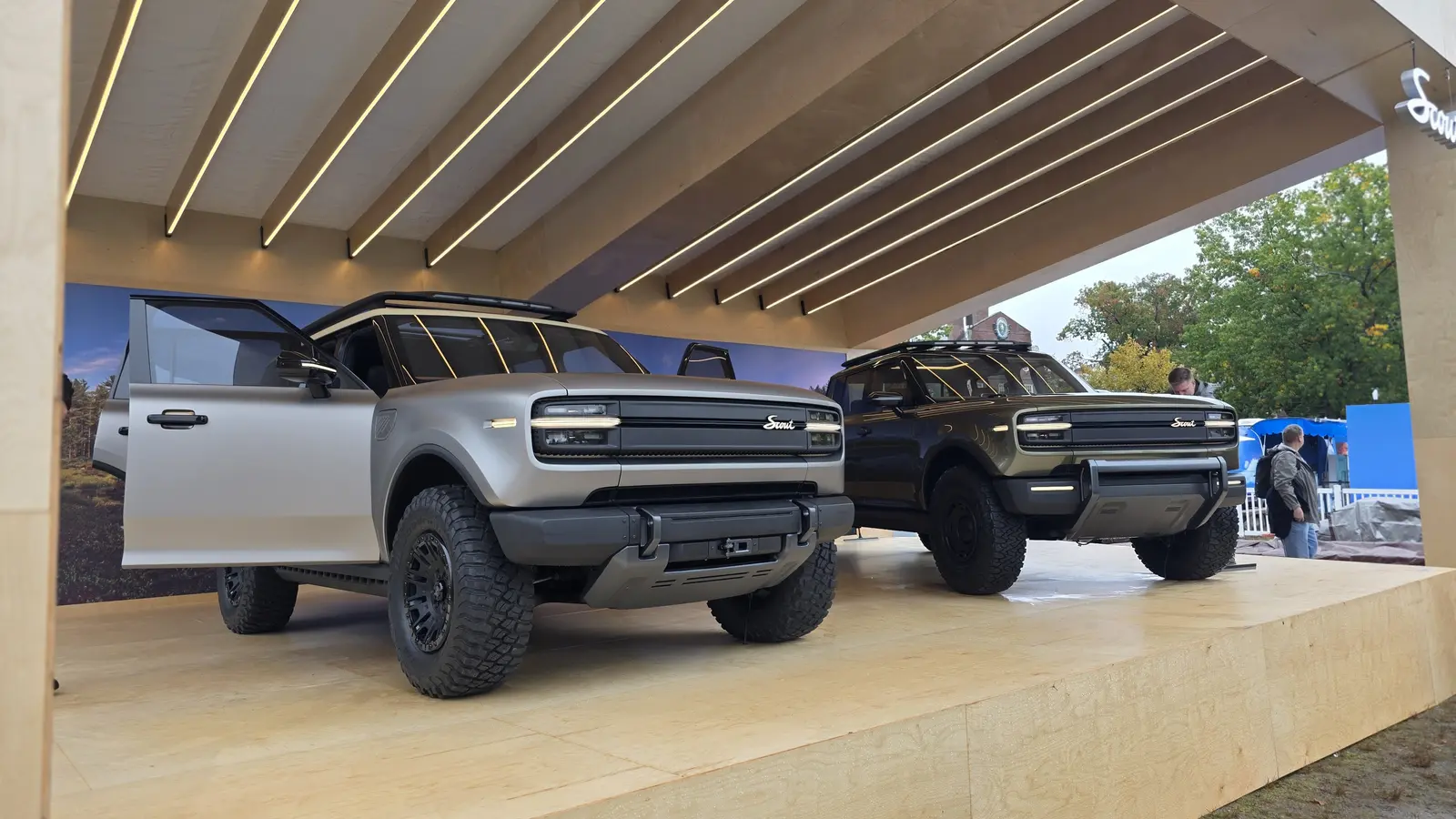
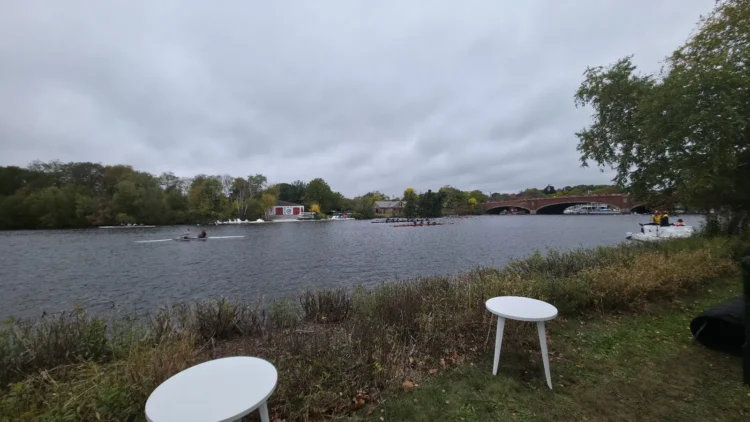
Scout’s main display was in Riverside Park on the Cambridge side, right next to the Weeks Footbridge. Both concepts sat on a raised platform under an open-sided timber pavilion with the river directly behind them, which put the trucks a few steps off the spectator path and in plain view of the racecourse. Friday is the practice day, so the crowd was steady but light, and a hard rain the night before had left mud and puddles everywhere. Scout staff were on hand all day to answer questions, and tell the brand’s story.
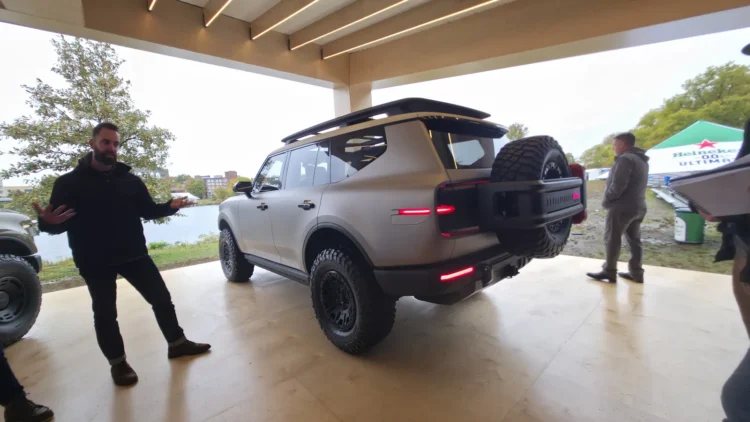
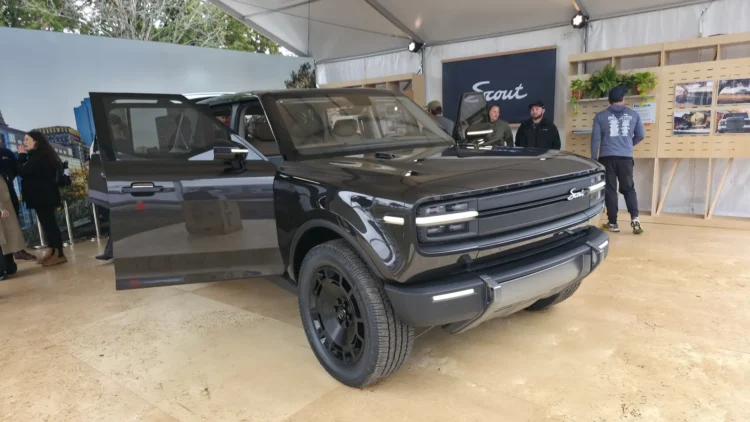
A second, smaller display sat in the hospitality area near the Eliot Bridge: a black Traveler under a tent, next to a pegboard wall of printed renderings and brand material. So between the two spots, Scout had both the general crowd along the course and the invited guests in the hospitality enclosures covered.
How close are the Scout concepts to production?
Roughly 80 to 85 percent, by Scout’s own framing. Both vehicles are concepts, and the Scout reps were upfront about it: details are still subject to change as the production trucks go through validation. My read is that the number is a hedge, and a sensible one. It gives Scout room to change any small detail that turns out to be too complex or too expensive to manufacture without anyone calling it a broken promise. That said, the concepts have looked essentially like this since the brand’s reveal in October 2024, so the direction is set. What you see is the plan.
Visually, the Traveler and Terra share a face: flat front end, full-width light bar, Scout script on the nose, and exposed bumper and tow hardware. The pair at Riverside Park rode on knobby all-terrain tires with short overhangs, a clear nod to the original International Harvester Scout’s reputation as a simple, capable off-roader, while the Traveler at the Eliot Bridge display wore street tires and black wheels. The Traveler, the SUV, hangs its full-size spare on a side-hinged rear gate, and the roof rails and rack are built into the roof instead of bolted on afterward.
A spec placard next to the Eliot Bridge Traveler listed it at 190 inches long, 80 inches wide without mirrors, 75 inches tall, and a 118-inch wheelbase, with a panoramic sunroof as an option. For context, that’s about the length of a four-door Ford Bronco and well short of a Chevrolet Tahoe. The placard’s fine print says the figures are preliminary and subject to change before production.
Inside the Scout Traveler and Terra concepts
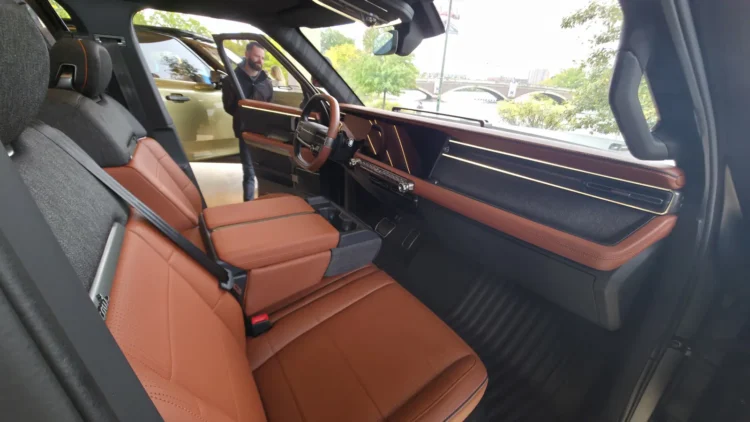
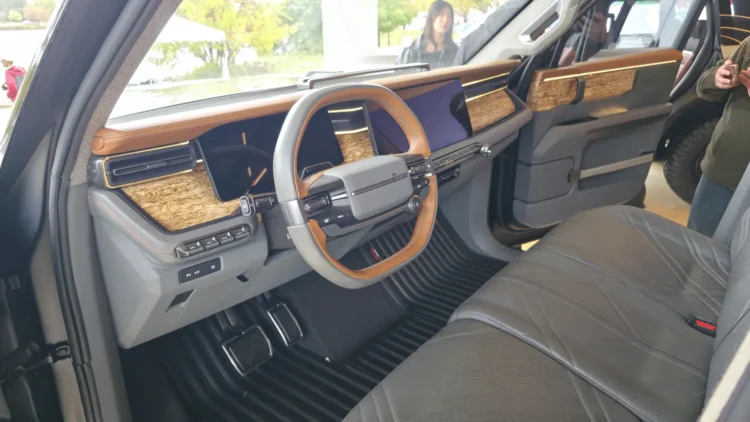
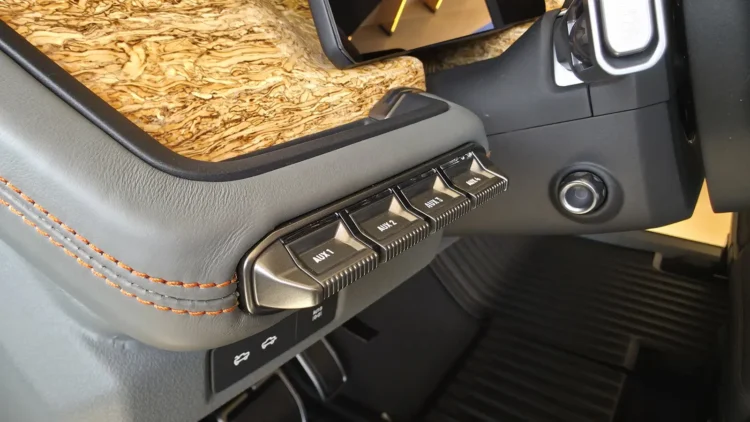
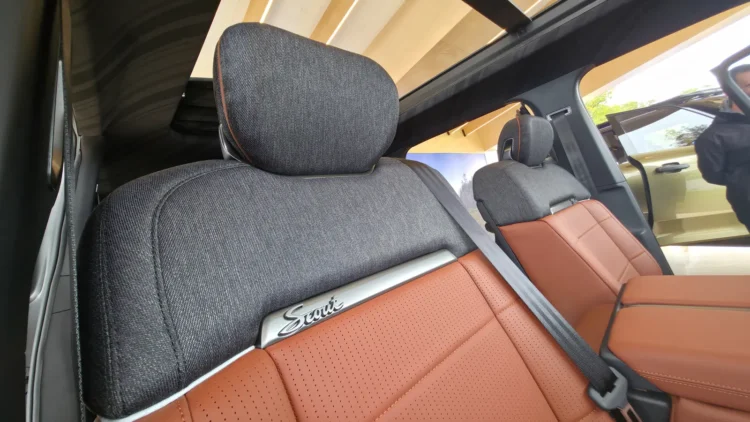
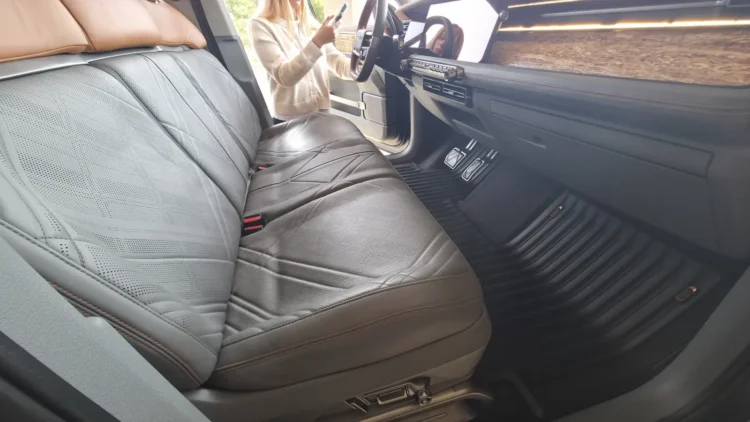
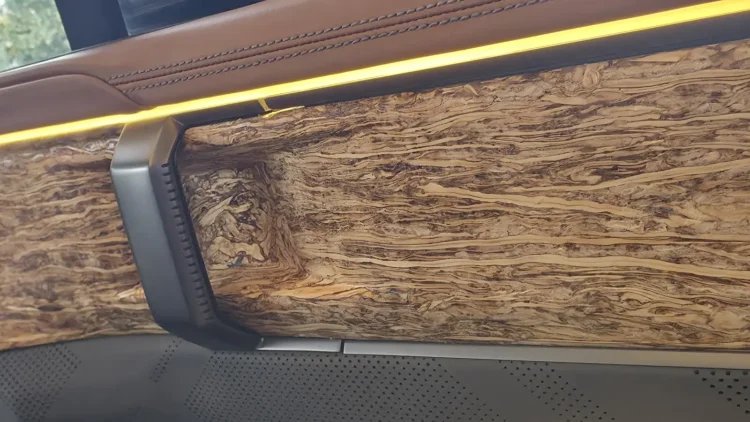
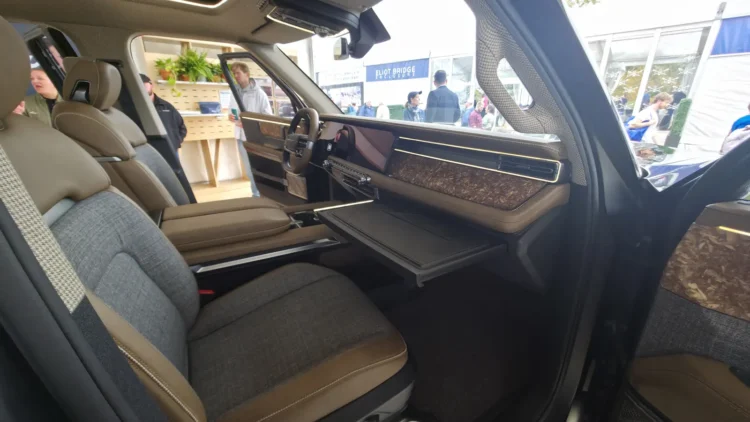
The interiors are where the concepts earn their crowd. Scout mixed gray and cognac leather with a denim-style woven fabric on the seats and headrests, then ran wide panels of figured wood across the dash and doors with a thin strip of amber ambient light above them. The floors are molded rubber, not carpet. One wide display spans the top of the dashboard, but below it Scout kept a real row of physical switches and knobs, including a bank of four labeled auxiliary switches on the dash for powering accessories like lights or a winch. One concept also had a fold-out tray table on the passenger side of the dash.
The materials are the real thing: the leather, the woven fabric, and the wood all feel like finished production pieces rather than show-car stand-ins.
Will every one of those details make it to production? Probably not all of them. But the basic approach of pairing one big screen with tactile physical controls matches what Scout has said publicly about the trucks, and it’s the part most people I watched lean in seemed to notice first.
Who is Scout Motors?
Scout is a revived nameplate, not a startup. International Harvester built the original Scout from 1961 to 1980, and it’s generally credited as one of the first vehicles in what became the modern SUV segment. The trademark ended up with Volkswagen Group through its purchase of Navistar, International Harvester’s successor, and in 2022 Volkswagen announced it would bring Scout back as an independent, American-based brand. Scout Motors is headquartered in the United States and is building its production facility in Blythewood, South Carolina.
Both the Traveler and the Terra are body-on-frame vehicles designed from the start as electric trucks. Scout has also announced an optional gasoline range extender, which it calls Harvester, that uses a small engine to generate electricity for the battery on long trips. Scout says it’s targeting starting prices under $60,000 for both, with lower numbers possible depending on available incentives, and it has been taking $100 refundable reservations since the 2024 reveal.
When the Scout Traveler and Terra arrive
According to Scout’s announcement of the regatta partnership, initial validation vehicles start production at the South Carolina plant in 2026 and continue into 2027, with customer deliveries expected to begin in 2028. For anyone with a reservation, the practical math is simple: the trucks on the Charles are still at least a year and a half from a driveway.
The takeaway from Cambridge
Three things stood out. The materials and finish on the concepts are a level above a typical show vehicle, which suggests Scout is treating the interior as a core part of the product and not something to value-engineer later. The Scout staff knew the trucks and were candid about what’s still undecided, which isn’t always the case at a brand activation. And even on a muddy practice day, people kept lining up to excitedly take a look at the concepts.
Final pricing, final specs, and whether the 2028 delivery timeline holds are still open questions, and they’ll be answered in South Carolina, not on the Charles. But a brand that has to introduce itself to New England from scratch picked a reasonable place to start.
Photos by Zane Merva for DrivingNewEngland.com